Match tracking & campaigns
How to review your FC 27 Champions campaign beyond wins and losses
Review your FC 27 Champions campaign with match scores, useful stats and comparable records. A practical guide to deciding what to track next.
· 6 min read · Onstreak
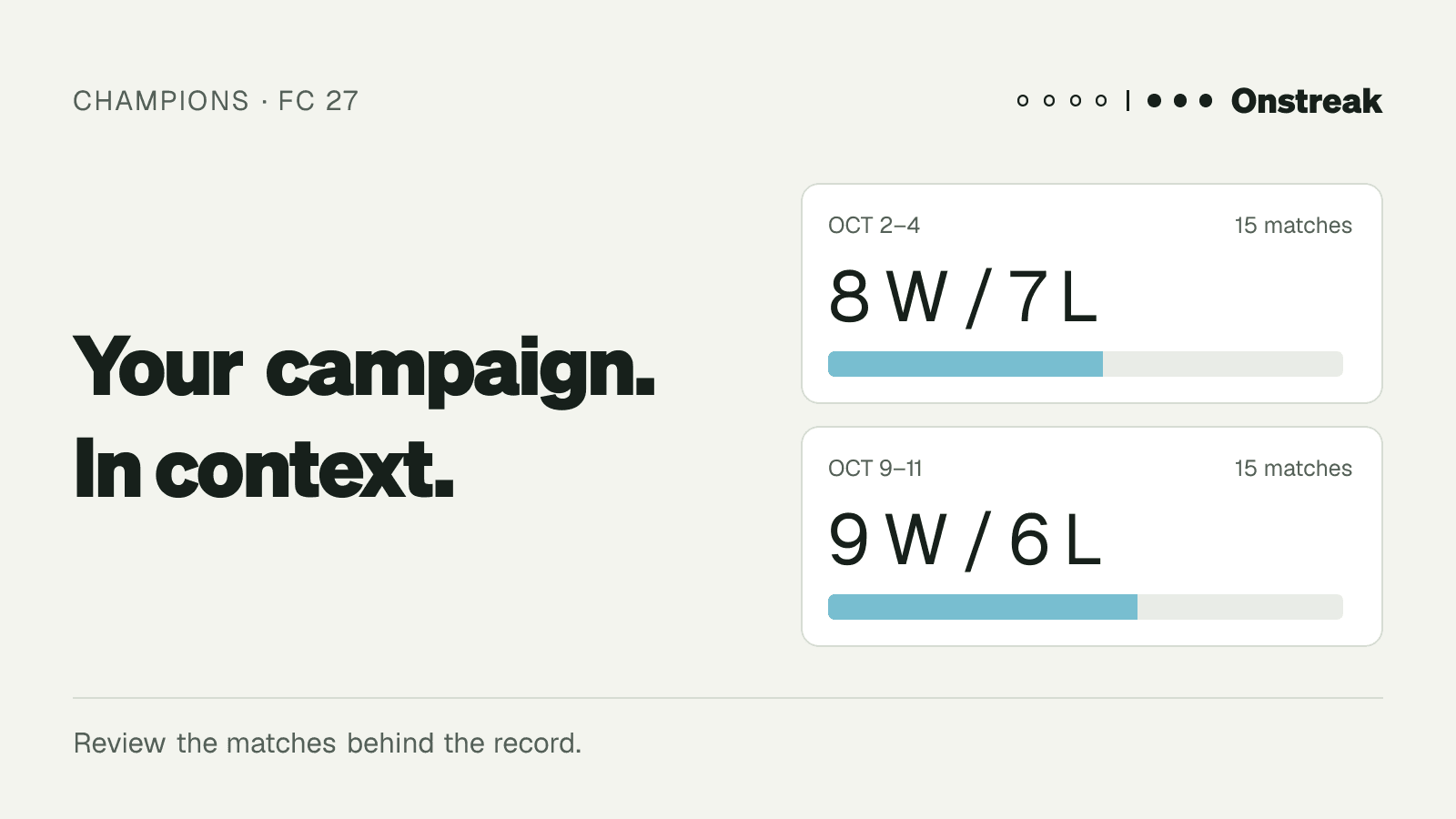
You finished your FC 27 Champions campaign with nine wins and six losses. Last time, you went eight and seven. The record changed. What else can you actually say about the matches?
A useful review starts with the scores you kept, checks whether your record is complete, and adds only the statistics you have. Then you compare like with like and choose something to follow next. You can do this in Onstreak, a spreadsheet or a notebook. You do not need a full set of advanced stats to begin.
1. Separate your final record from the matches you recorded
Write down the campaign, game edition, dates and number of matches recorded before interpreting the result. A complete campaign and a few saved games answer different questions. If you only kept your five best matches, their scores cannot stand in for the whole run.
There is also a difference between a campaign result and match evidence. A final record can include unplayed losses when the campaign format and confirmed coverage establish them. Those are not matches with zero shots, zero goals or zero xG. If you do not know whether every played match was saved, keep that uncertainty visible rather than filling the gaps.
- Which campaign and edition am I reviewing?
- How many played matches did I record?
- Is the result final, still in progress or incomplete?
- Do any results need checking before I use them?
2. Read the sequence behind the total
Look at the matches in order. In our fictional example, the last five scores are 3–1, 1–2, 2–0, 2–3 and 3–2. That is three wins and two losses, with 11 goals scored and eight conceded. The sequence gives you something specific to revisit that a final 9–6 record leaves out.
You can identify a close match or a high-scoring stretch without claiming to know its cause. A late run of losses does not establish fatigue. Two wins after changing formation do not establish that the formation worked. If you want to examine a particular situation, replay footage or a note made at the time can add context that the score cannot supply.
3. Add the stats that answer your question
Start with goals scored and conceded. If you saved shots, use them to describe how often you or your opponents shot. If you also have xG, it adds another view of the recorded chances. None of these measures, alone, explains why you won or lost.
Choose a question before adding columns. Were your recent games higher scoring? Did you record more shots per match? Were opponents taking more shots? One clear question is easier to examine than a page of numbers with no purpose.
Keep the sample count beside each average. Shots recorded in six matches means a six-match shots sample, even if the campaign contains fifteen results. Missing shots are unknown, not zero. If the matches with stats are an unusual subset, say so; a larger number on the screen does not remove that selection problem.
Recording the score manually is a legitimate starting point. Add other fields when they are available and useful to you. Scanning a screenshot is another way to collect data, but check the extracted values before saving. The collection method does not make a statistic more trustworthy than the evidence behind it.
4. Compare campaigns with the same context
Use another Champions campaign from the same game edition, and state the dates and recorded sample for both. Rivals and Champions should not be pooled into one comparison. A partial campaign should stay labelled partial, even when its average looks more flattering.
| Recorded measure | Oct 2–4 | Oct 9–11 |
|---|---|---|
| Matches recorded | 15 | 15 |
| Wins / losses | 8 / 7 | 9 / 6 |
| Goals scored | 24 | 27 |
| Goals conceded | 26 | 25 |
In this example, the second campaign contains one more win, three more goals scored and one fewer goal conceded. Those are descriptive differences across two sets of matches. They do not prove improved finishing, better defending or the effect of a tactical change.
The totals are readable here because both campaigns have fifteen recorded matches. With different sample sizes, totals alone can mislead: more matches create more opportunities to score. Look at the appropriate per-match measure and its coverage instead, while keeping the difference in sample size explicit. An average based on one match is still an observation about one match.
5. Leave with one observation and one open question
A useful review can be short: “I recorded 27 goals across 15 matches, compared with 24 across the previous 15. I want to keep shots next time to see whether shot volume changes too.” You have a fact, a reference and a reason to collect the next piece of evidence.
“I cannot compare shots yet because I only saved them for two games” is useful too. It tells you exactly what is missing. You do not need to turn every review into a diagnosis or choose a new formation after every campaign.
If you decide to test a playing behaviour, separate that experiment from the result review. Define what you intend to try and what you will observe. A later difference in the numbers still will not establish that your change caused it.
6. Carry your review into the next campaign
Before the next run, decide what you want to keep. That might be every score, one additional measure or a personal result target. Pick something you can actually record. A target is your intention, not a prediction of where you will finish.
In Onstreak, add your matches, revisit them in Competition and use the available Trajectory readings to compare your recorded game. Manual entry is unlimited on Free. Optional Champions preparation with Pro lets you keep a chosen formation, a measure and an optional win target. Those choices belong to you; saving them does not activate a coaching Focus.
See Onstreak's match tracking and campaign features
A short checklist for your campaign review
- Name the campaign, mode, edition and dates.
- Check how many played matches and results you actually saved.
- Read the score sequence before looking for an explanation.
- Choose the statistics that answer your question, with a sample count for each.
- Compare compatible campaigns and keep missing evidence visible.
- Write one supported observation and decide what to record next.
Your final record is worth keeping. The matches behind it are what let you return later and ask a more useful question.
Keeping a record gives you something to look back at. With Onstreak’s personal match tracker, you can record your EA SPORTS FC 27 matches, follow your Rivals and Champions campaigns, and revisit your match history, stats and factual trends in the data you have recorded. The Coach is optional.
You can enter matches manually or capture match stats from screenshots, check the information, and save the match to your history.
See what shows up in your own game. Start free with Onstreak.